
Inter-domain distance analysis reveals conformational changes in the Keap1-Nrf2 stress sensor system
A research group led by Professor Seizo Koshiba (INGEM, Tohoku University) and Special Honorary Professor Masayuki Yamamoto (Tohoku Medical Megabank Organization, Tohoku University), including Ritsumi Saito and Seisuke Yamashita (INGEM, Tohoku University), in collaboration with Chugai Pharmaceutical Co., Ltd., quantitatively analyzed the conformational changes of Keap1, a protein that regulates Nrf2, which protects cells against oxidative stress, using cryo-electron microscopy (cryo-EM).
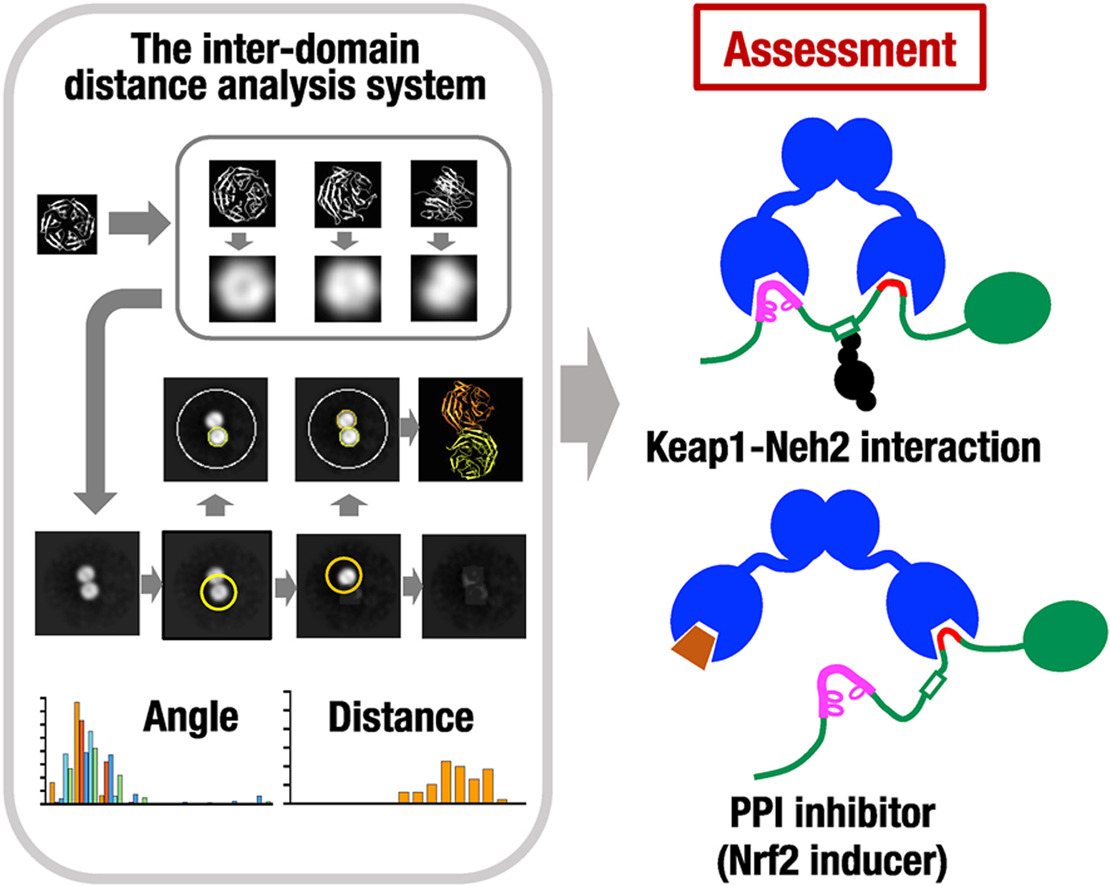
The researchers found that Nrf2 binding brings the two binding sites of Keap1 closer together, while a compound that inhibits this interaction increases the distance between them.
These findings shed light on the mechanisms regulating oxidative stress responses and may contribute to the development of novel Nrf2 activators with fewer adverse effects.
The study was published in the November 2026 issue of Redox Biology.
Highlights
•Cryo-EM analysis indicates conformational diversity in full-length Keap1.
•A cryo-EM–based system quantitatively evaluates Keap1 domain-distance diversity.
•Nrf2 binding and a protein-protein interaction inhibitor alter Keap1 conformation.
•Three flexible regions contribute to Keap1 structural flexibility.
Abstract
The Keap1-Nrf2 system plays a central role in cellular defense against oxidative stress. Structural information on full-length Keap1 is essential for understanding the molecular basis of this regulation. However, its overall architecture has remained elusive due to pronounced conformational flexibility. In this study, we performed single-particle cryo-electron microscopy (cryo-EM) analysis of full-length Keap1 and found multiple particle conformations accompanied by severe preferred orientation in vitrified ice. To address these problems, we developed an analytical system that focuses on measuring the inter-domain distance between the two DC domains of the Keap1 homodimer. Using this approach, we identified the change of inter-domain distance distributions of Keap1 induced by Nrf2 binding or its inhibition, suggesting that these conformational changes are associated with Nrf2 regulation. Furthermore, through integration of this system with Keap1 deletion mutants, three flexible regions within Keap1 are found to contribute substantially to the conformational flexibility of the Keap1 homodimer. Together, these findings provide structural insights into the dynamic changes of the Keap1-Nrf2 system that would contribute to the development of Keap1-targeted therapeutics.
Graphical abstract
Keywords
Keap1; Nrf2; cryo-EM; Protein-protein interaction inhibitor
Publication Details
Title: Inter-domain distance analysis reveals conformational changes in the Keap1-Nrf2 stress sensor system
Authors: Ritsumi Saito, Takeshi Kawabata, Seisuke Yamashita, Keisuke Oki, Takashi Fujii, Hiroki Kawauchi, Yoshiaki Doi, Machiko Irie, Takuya Torizawa, Kengo Kinoshita, Masayuki Yamamoto, Seizo Koshiba
Journal: Redox Biology
DOI: 10.1016/j.redox.2026.104379